

Importance of Early Autism Diagnoses
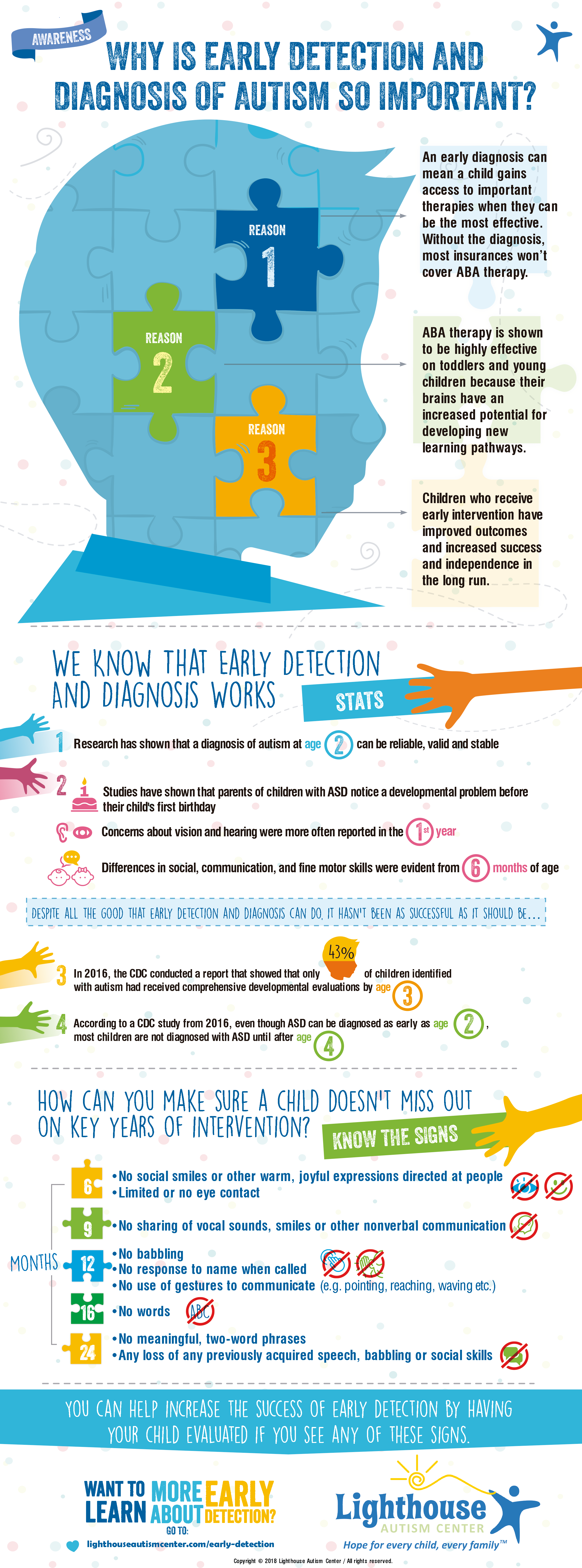
Our in-depth infographic explains the importance of early detection and diagnosis in autistic children. We also identify some of the early signs to look out for.
INFOGRAPHIC: Why is Early Detection and Diagnosis So Important?
What is Autism?
Autism spectrum disorder (ASD) is a developmental disability that can cause significant social, communication, and behavioral challenges. About 1 in 36 children has been identified with autism spectrum disorder (ASD), according to estimates from CDC’s Autism and Developmental Disabilities Monitoring (ADDM) Network. People with ASD have abilities that vary significantly. Autism affects each person differently, making it truly a spectrum disorder. People with autism may behave, communicate, interact, and learn in ways that are different from most other people. Some people with ASD need a lot of assistance, whereas others live very independently with little to no support.
Autistic individuals typically do not have any identifiable defining physical features that set them apart from other people, and the characteristics of autism often become more obvious when judging against behavioral milestones. Some children show symptoms of autism within the first 12 months. In others, symptoms may not show up until 24 months of age or later. Some autistic children gain new skills and meet developmental milestones until around 18 to 24 months of age, and then they stop gaining new skills or lose the skills they once had.
Signs and Symptoms
People on the autism spectrum often struggle with social interactions and communication, as well as repetitive and restrictive behaviors. It’s important to recognize the signs of early autism to get a diagnosis as soon as possible.
Some of the most common early signs of autism in babies typically include:
- No social smiles or other joyful expressions for caretakers or parents,
- Limited or no eye contact,
- No sharing of vocal sounds, smiles, or other nonverbal communication,
- No babbling, and
- No response to being called by their name.
The early signs of autism in toddlers typically include:
- No use of gestures to communicate, such as pointing, reaching, or waving,
- No words or verbal communication,
- Loss of any previously acquired speech, verbal communication, or social skills, and
- Loss or pause of obvious physical development milestones like eye contact and smiling.
Learn more about the early signs and symptoms of Autism Spectrum Disorder.
Learn more about important milestones that your child should reach.
Evaluating your Child
Are you seeing the signs of autism in your child but don’t have an evaluation yet? Early detection and diagnosis are crucial to improved outcomes and increased success and independence in the long run. View our list of early signs and symptoms of autism in babies, toddlers, and young children. Then, connect with Lighthouse’s network of professionals who have the expertise to fully evaluate your child with a comprehensive autism evaluation.
Together, we can unlock your child’s potential
Related News
03/10/2026
What is Verbal Behavior Therapy?
Verbal Behavior Therapy is a vital tool for helping those with autism improve their communication skills. Learn more about this approach to teaching communication and the benefits it offers children with autism. Understanding VBT and Its Impact Communication is the foundation of human interaction, enabling us to connect, share ideas, resolve conflicts, and collaborate with others in […]
03/10/2026
What Is a Co-Treatment Therapy Session?
Explore co-treatment with ABA therapy with speech support for comprehensive care, improved communication, and effective outcomes in children. What Is a Co-Treatment Session and How Does It Benefit Your Child? ABA (Applied Behavior Analysis) therapy programs are designed by a Board Certified Behavior Analyst (BCBA) and implemented by a Registered Behavior Technician (RBT) to address behavior-related goals in autistic children. […]
03/10/2026
Safety & Autism Centers
Safety & Autism Centers: How LAC Prioritizes Safety As a parent, trusting anyone with the safety of your child is a big ask, even more so when you know that your child sees, feels, and experiences the world differently. At Lighthouse Autism Center, we understand that safety means more than locked doors or clean playrooms. […]
